Presentation
Keywords:
PresentationAbstract
The intensifying climate emergency is shifting the environmental debate to the center of discussions on development, democracy, and social justice. It is becoming increasingly evident that the effects of the crisis are not distributed evenly; rather, they deepen historical inequalities, create new forms of vulnerability, and highlight conflicts over access to the commons, development models, and the rights of peoples and communities.
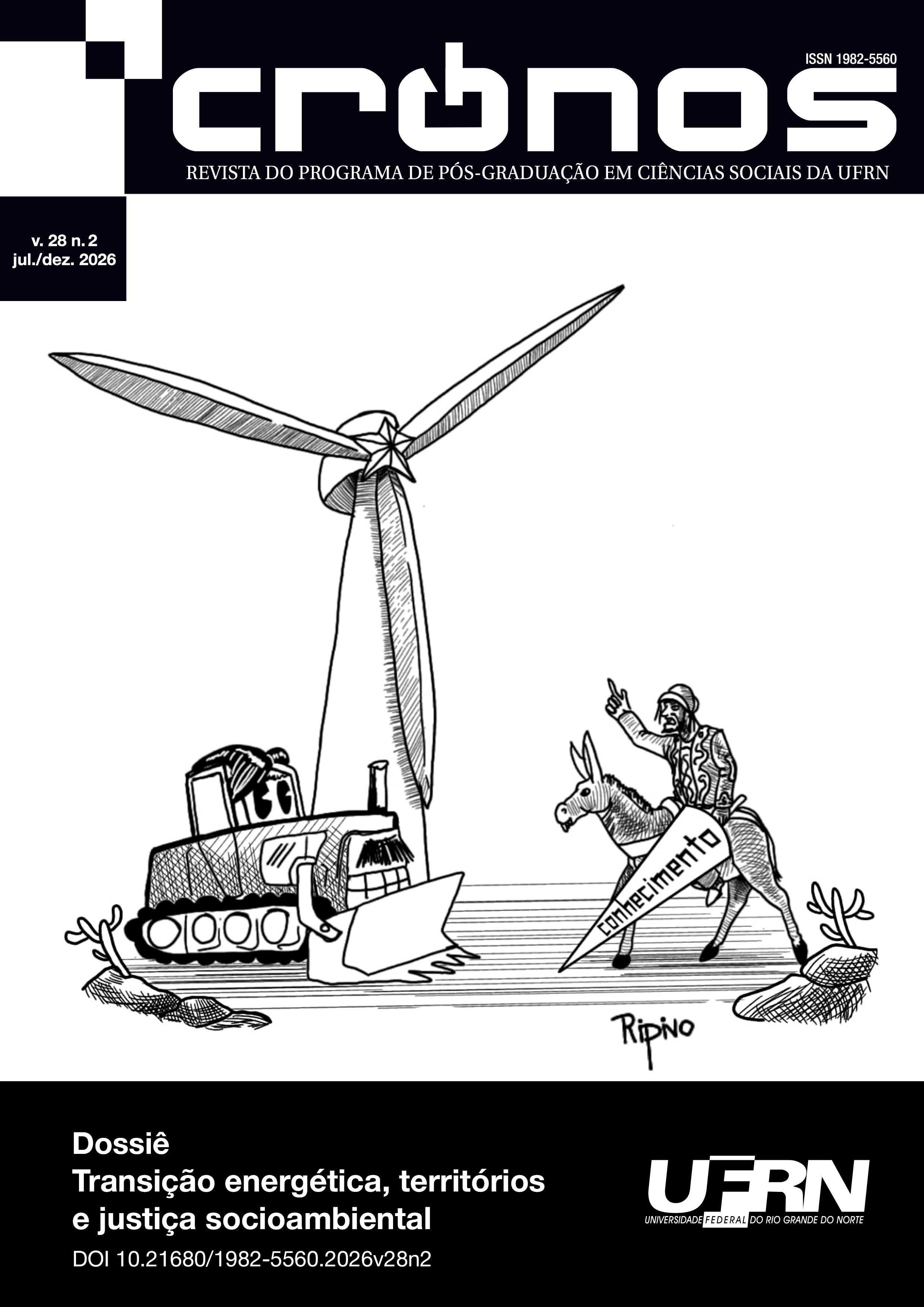
Paradoxically, the strategies devised to address the climate crisis have also come under increasing scrutiny. In various contexts, initiatives designed to promote emission mitigation and climate adaptation—when driven by neo-extractivist rationales—can reproduce historical dynamics of dispossession, displacement, and inequality, thereby turning the climate transition itself into a new arena of territorial, political, and epistemological conflict.
In this light, solutions proposed to address the climate emergency are no longer viewed as neutral or consensual responses; instead, they are part of a broader debate on climate justice, human rights, development models, and territorial governance. At the same time, the texts gathered in this dossier demonstrate that certain decarbonization strategies can reinforce the financialization of nature, land concentration, territorial dispossession, and economic dependency, revealing that the energy transition is also a site of contestation regarding the appropriation of natural resources, the distribution of benefits, and the creation of new inequalities.
It is within this context that this dossier is presented, comprising ten articles and one interview that explore various facets of the contemporary climate crisis. The contributions analyze adaptation and mitigation processes, public policies, territorial conflicts, the energy transition, climate governance, socio-environmental justice, and the experiences of diverse social actors facing the challenges posed by global warming. In doing so, the articles not only examine the impacts of climate change but also critically interrogate the economic, political, and institutional models guiding responses to the crisis, discussing who bears the costs, who benefits from the outcomes, and what visions of society are produced under the discourse of sustainability.
Downloads
Downloads
Published
How to Cite
Issue
Section
License
Copyright (c) 2026 Revista Cronos

This work is licensed under a Creative Commons Attribution-NonCommercial-ShareAlike 4.0 International License.
 English
 Español (España)
 Português (Brasil)